What's Actually Happening in Florida's Foreclosure Market
Florida has become the state with the highest foreclosure rate in the country. According to ATTOM Data Solutions, roughly 1 in every 2,300 housing units in Florida is currently in some stage of foreclosure, a rate the research and analysis channel Reventure Consulting says is 10 to 20 times higher than states with the lowest foreclosure activity.
The driver isn't a single shock. It's a home-price downturn that has been building for two years, layered on top of a wave of pandemic-era construction and low-down-payment lending. Statewide, typical values have been drifting lower region by region since 2024. In the hardest-hit pockets, prices are already down more than 20% from their peak four years ago, and individual distressed listings are showing discounts even steeper than that.
This matters beyond Florida. The state absorbed one of the largest population and construction booms of the pandemic era, and it's now serving as an early test case for what happens when that kind of growth cools quickly. Buyers, sellers, and owners elsewhere in the Sunbelt are watching Florida for signs of what could come their way.
Ground Zero: Davenport and the Pandemic Building Boom
Reventure Consulting's on-the-ground reporting focused on Davenport, a Central Florida town in Polk County sitting between Orlando and Lakeland. Polk County was one of the fastest-growing counties in the country by net migration in 2021, 2022, and 2023. Builders responded by adding large volumes of new subdivisions, many marketed to buyers using FHA and VA loans that allowed down payments as low as 0% to 5%.
That financing structure matters now. Borrowers with little equity have far less cushion when home values fall, which raises the odds of delinquency, short sale, or foreclosure once prices turn down. A few examples documented in the video illustrate the scale of the reversal:
- A four-bed, three-bath home bought for $385,000 in 2022 is listed today as a lender-approved short sale for $295,000, a $90,000 markdown.
- A separate home sold for $325,000 in 2021 has sat on the market for nearly six months at $344,000, just 5% above its 2021 price after an estimated peak value near $450,000.
- A new-build townhouse that sold for $282,000 in 2021 is now listed at $199,000, alongside a nearly identical unit next door also listed as a short sale.
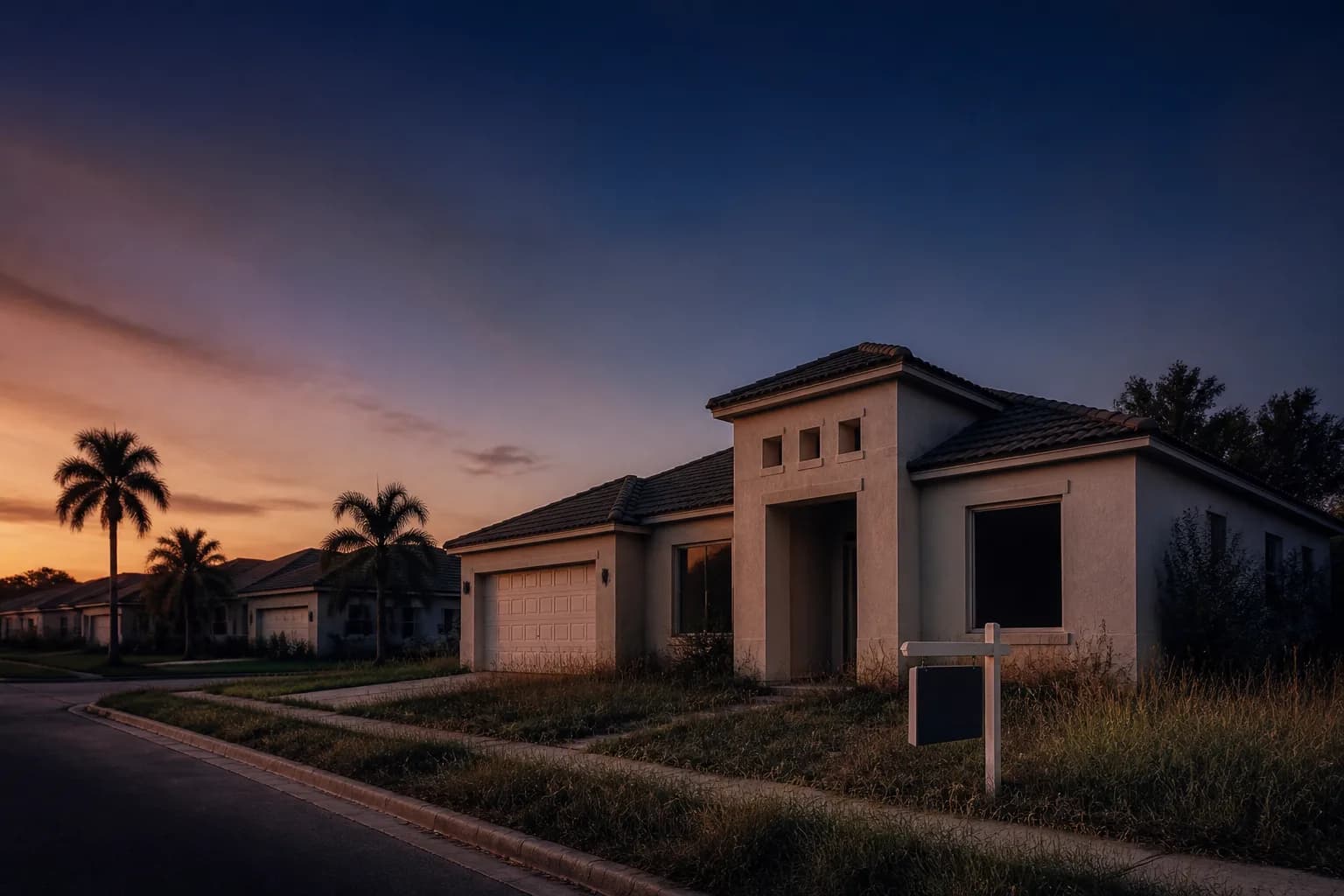
Reventure Consulting also pointed to visible signs of distress common in Davenport-area subdivisions: overgrown lawns, homes that neighbors say have sat vacant for months, and in one case furniture left on a front lawn, which can indicate an eviction. These are qualitative observations from a single reporting trip, not a formal vacancy count, but they're consistent with the broader pattern of falling migration and rising supply in the area.
Which Florida Counties Have Lost the Most Value
Not every part of Florida is falling at the same pace. Reventure Consulting's county-level data, covering typical home value changes since 2022, shows the sharpest declines concentrated on the Gulf Coast and in newer boom markets:
| County | Metro area | Change since 2022 peak |
|---|---|---|
| Charlotte | Punta Gorda | -22% |
| Lee | Cape Coral-Fort Myers | -17% |
| Sarasota | Sarasota | -16% |
| Manatee | Between Sarasota and Tampa | -13% |
| Flagler | Palm Coast | -12% |
| Collier | Naples | -10% |
| Pasco | North of Tampa | -7% |
| Pinellas | St. Petersburg-Clearwater | -7% |
| St. Johns | South of Jacksonville | -6% |
| Sumter | The Villages area | -5.6% |
| Polk | Lakeland-Davenport | -5.4% |
Polk County's average decline of 5.4% looks mild next to Charlotte or Lee counties, but Reventure Consulting argues the countywide average understates the pain because it blends stable neighborhoods with newer subdivisions where individual listings are down 20-30%. In a market with distressed sellers, those steep individual discounts, not the countywide average, tend to signal where new buyers can actually transact.
The Pockets of Resilience
Several Florida counties have avoided the downturn so far. Since mid-2022, Miami-Dade values are up 12.6%, Leon County (Tallahassee) is up 7%, Highlands County is up 6%, Broward County is up 4%, Alachua County is up 3%, and Escambia County is up 2%.
Reventure Consulting cautions that this resilience is fading, not permanent. Miami-Dade values have started falling year-over-year even though they remain well above 2022 levels. The picture can also vary block by block: within Miami-Dade, some zip codes such as Coral Gables are still appreciating, while others nearby are down 5-7% year-over-year. That kind of hyper-local variation is a reminder that any single "Florida is up" or "Florida is down" headline is an oversimplification, since the real answer depends on the zip code and even the subdivision.
Wall Street Landlords Are Pulling Back Too
Investors were a major source of demand during Florida's 2021-2022 boom, and Reventure Consulting says they're now a source of weakness. Investor purchases in Florida are down an estimated 50-70% over the past four years, driven by rising property taxes, higher insurance premiums, and softening rents that make the math on rental properties less attractive.
One example cited in the reporting: institutional landlord Main Street Renewal bought a four-bed home in the Davenport area for $360,000 near the market peak. The advertised rent has since been cut from roughly $2,730-2,740 a month to about $2,460, a decline of roughly $250-280 a month. When rents fall, the amount an investor can justify paying for a property falls too, which adds further downward pressure on prices in investor-heavy neighborhoods.
The Property Tax Ballot Measure That Could Change the Trajectory
One potential offset is on Florida's November 2026 ballot. Governor Ron DeSantis has pushed to reduce or eventually eliminate property taxes for homesteaded owners, and one proposal would raise the homestead exemption to $200,000. To take effect, the measure needs at least 60% voter approval.
Key details worth noting:
- The exemption would apply only to primary, homesteaded residences, not investment or rental properties.
- Eligibility would require at least five years of Florida residency, specifically to prevent a rush of new buyers moving in solely to claim the break.
- Critics, per Reventure Consulting, worry about how local governments would fund schools, police, and fire services if the tax base shrinks.
If passed, some buyers and analysts believe the measure could boost demand in late 2026 and into 2027 by lowering the ongoing cost of ownership. That's speculative, and it would take time for any demand effect to show up in sales data. It's a variable to track, not a resolved outcome.
Is This Really 2008 Again? A Reality Check
It's worth putting the current numbers in historical context. Florida's foreclosure share today is roughly half of one percent of homes, according to the historical data Reventure Consulting cites. During the 2008-2010 crisis, foreclosure rates in Miami, Tampa, and Orlando reached the high single digits and, in some cases, double digits. By that measure, Florida is roughly one-eighth to one-tenth of the way toward 2008-era distress levels, not there yet.
Reventure Consulting's counterpoint is that price declines on individual, currently-distressed listings already resemble crash pricing, even though the foreclosure rate is still historically low. In other words, the pain shows up first in scattered, sharp discounts on specific homes before it shows up in aggregate statistics. Whether that turns into a broader downturn likely depends on the wider economy. A jump in the national unemployment rate to 6-7% would remove income-supported demand and could accelerate the trend. As of now, there's no confirmed recession, and Florida's price declines remain regionally concentrated rather than uniform.
It's also fair to note that Reventure Consulting sells a paid forecasting and listing-analysis product, which gives it a commercial incentive to frame the market as risky enough to warrant a subscription. That doesn't make the underlying ATTOM foreclosure data or the price figures wrong, but readers should weigh the analysis independently of the sales pitch attached to it.
For context on how oversupply plays out elsewhere in fast-growing Sunbelt markets, see our coverage of how Arizona's water limits are freezing new home construction and why cheap Florida farmhouses with acreage aren't selling, both of which show how local supply and demand imbalances can diverge sharply from national headlines.
What This Means for Buyers, Sellers, and Owners
If you're a buyer or investor: Discounted and short-sale listings in Florida may represent real opportunity, but pricing varies enormously by county and even zip code. Before making an offer, check recent comparable sales in that specific neighborhood, not just the county average, and confirm whether local supply, such as new construction or investor-owned rentals, is still rising. Mortgage rate movements, tracked via Freddie Mac's Primary Mortgage Market Survey, will also affect your carrying costs and negotiating leverage.
If you're selling in a soft Florida market: Pricing to last year's comps may no longer work in fast-declining counties. A short sale or lender-approved discount, while painful, can be the fastest route out if you're underwater and need to relocate for work or other reasons. Consult a housing counselor or real estate attorney before pursuing one.
If you're a current owner: A falling value on paper doesn't force any action if you can keep making payments and don't need to sell soon. Owners with low down payments from FHA or VA loans taken out between 2021 and 2023 should pay closest attention to local price trends, since they have the least equity cushion.
If you're watching from outside Florida: The state's mix of heavy pandemic-era construction, investor concentration, and high insurance and property-tax costs is a useful case study for evaluating similar risk factors in other boom markets, including parts of Texas, Arizona, and the Carolinas.