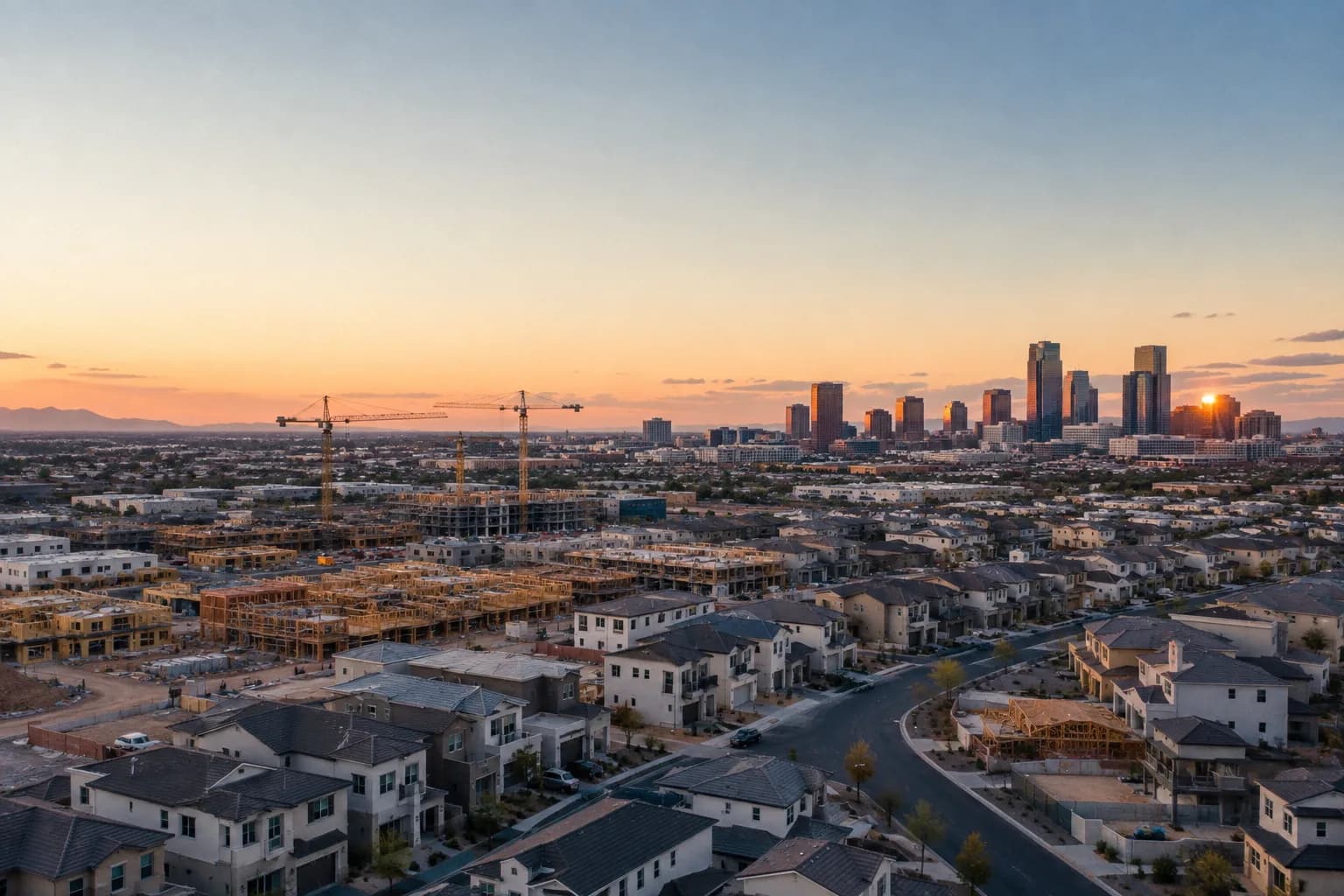
Why Phoenix Buyers Are Second-Guessing the Market
Phoenix buyers aren't walking away from real estate. They're walking away from a single assumption: that owning a home here automatically means it gets more valuable every year.
That's the real story behind a public disagreement between two well-known Phoenix real estate figures, and it matters for anyone weighing a purchase in the Valley this fall. Metro-wide prices have been essentially flat for about four years, mortgage rates are still above 6%, and yet sales volume is climbing while inventory is shrinking. Those three things happening together, according to local data, don't describe a market falling apart — they describe a narrowing window for buyers to negotiate before conditions tighten further.
The Warning: A Broker Says Belief in Home Equity Is Fading
Greg Hague, who runs 72 Sold in Scottsdale, told the Phoenix Business Journal that the conviction a home reliably builds wealth is eroding "a little bit more every month," in his words. His reasoning: once a buyer starts asking why they should pay for something that isn't appreciating, they hesitate, delay, and eventually talk themselves into staying put.
Hague's warning carries an edge. He argues that if that hesitation spreads across the buyer pool, it wouldn't just slow the market — in his words, it would "gut it."
He points to real numbers to back up the concern:
- Metro Phoenix prices slipped about 1.65% year-over-year as of April 2026.
- Home values across the Valley have been largely flat for roughly four years.
- Transaction volume — the number of homes actually changing hands — is running about 28% below pre-pandemic levels.
Layer on 30-year mortgage rates sitting above 6%, and Hague's concern is that buyers drift to the sidelines and simply stay there rather than transact at all.
The Rebuttal: "Demand Is Higher, Not Lower"
Mike Orr, who runs the Cromford Report — a data source widely used by Phoenix-area agents — publicly disagreed with Hague's read. Orr's core argument is that appreciation was never the primary reason most people bought a home in the first place; the financial math, he says, comes second to the decision to buy.
His key data point: demand in 2026 is somewhat higher than it was in 2025. Orr is careful to note that current demand still sits well below what he'd call a normal, balanced market — but the direction is upward, not downward.
A third voice adds a middle framing. Molly Boesel, a senior economist at Cotality (the data firm formerly known as CoreLogic), describes the current period as a "recalibration" rather than a collapse — essentially, the market resetting itself rather than breaking down. Boesel points to mortgage rates climbing back to around 6.3% in April 2026 as the trigger that deflated the spring selling season. Her takeaway for buyers: this stretch amounts to a genuine window to negotiate, a level of leverage buyers in this Valley simply didn't have four years ago.
What the Sales Data Actually Shows
So which read holds up when you check the numbers? The sales figures lean closer to Orr's and Boesel's argument than to Hague's alarm — though Hague's underlying price data is also accurate. Both things are true at once, which is exactly why the disagreement exists.
| Metric | Phoenix Figure | Context |
|---|---|---|
| Closed single-family sales, June 2026 YoY | +8% | National pace was about +3% the same month |
| Closed deals, first half of 2026 YoY | +5% | Fourth straight month of annual sales growth (Homes.com) |
| Median single-family sale price, June 2026 | Mid-$480,000s | Roughly flat versus a year earlier |
| Local affordability score | 73 | Up from a year earlier; more households qualify for mid-priced homes |
| Active listings, June 2026 YoY | -2% | Per Phoenix Realtors / MLS data |
| New listings, first half of 2026 YoY | -3.5% | Fewer owners choosing to list |
| Median days on market | ~64 days | Homes still take time to sell, but supply is tightening |
| 30-year fixed mortgage rate (end of July 2026) | 6.66% | Freddie Mac Primary Mortgage Market Survey |
Sales rising, supply falling, and prices holding flat rather than falling further — that combination is unusual for a market buyers are supposedly fleeing. A genuinely weakening market typically shows falling sales and rising, not shrinking, inventory. What the numbers actually describe looks more like tightening than deterioration.
Homes.com currently ranks Phoenix 18th out of the top 40 U.S. metros for price growth — modest, not exciting, but notably ahead of several Sunbelt metros in Texas and Florida that have posted larger price declines this year. For more on how those markets compare, see 10 Texas Cities Where Home Prices Are Falling Fastest in 2026 and 12 Florida Cities Where Home Prices Are Falling Fastest in 2026.
One Phoenix, Two Very Different Markets
The most important nuance in this debate is that "Phoenix" isn't really one market — it's several, and right now they're diverging sharply.
Take Scottsdale over the first half of 2026: closed sales rose more than 13%, the median price climbed well into the $1.2 million range, and homes going under contract were up more than 9%.
Now compare Glendale over the identical six-month window: closed sales fell a little over 4%, and homes going under contract dropped around 7%.
Same metro area, same six months, same mortgage-rate environment — opposite outcomes. That split is largely why the metro-wide "prices fell 1.65%" headline is misleading on its own. It's an average of a luxury tier that's still appreciating and a lower-priced tier that's cooling. Whether "now" is a good time to buy or sell in Phoenix depends far more on price range and submarket than on the metro-wide number.
This kind of local divergence isn't unique to Phoenix. Housing markets around the country increasingly reward a street-level or neighborhood-level view over a metro or state-level one — the same reason coverage of Fastest Growing Cities in the US: Where Movers Are Heading in 2026 and Colorado Mountain Towns With the Steepest Home Price Declines in 2026 keeps finding sharply different stories within the same region.
What This Means for You
If you're a buyer: Negotiating room in Phoenix is real, but it's thinner than it was six months ago and shrinking as new listings keep falling. Freddie Mac's Primary Mortgage Market Survey put the 30-year fixed rate at 6.66% at the end of July 2026 — flat home prices are largely what keeps monthly payments manageable at that rate. If prices start rising again while rates stay elevated, affordability could tighten quickly, so buyers weighing a purchase this fall have an argument for not waiting indefinitely.
If you're a seller: What's shifted in your favor is competition, not pricing power. Fewer homes are listed near yours, and fewer are coming behind you, per the new-listings decline noted above. What hasn't changed is that prices generally aren't climbing on their own anymore — pricing realistically to current comparable sales still matters more than it did during the 2021-2022 boom.
If you already own: A flat-price, lower-turnover market doesn't erase built-up equity from prior years, but it does mean betting on continued rapid appreciation is a weaker assumption than it was. Homeowners considering a move should weigh their current mortgage rate against today's rates before assuming a trade-up pencils out.
Where the Debate Falls Short
It's worth noting the limits of this debate. None of the three sources cited — Hague, Orr, or Boesel — is a neutral government statistical agency, and each has a commercial stake in how the market is perceived: Hague runs a brokerage, Orr sells a data subscription used by agents, and Boesel works for a firm that sells housing analytics to lenders and investors. Their read of "demand" and "recalibration" is a reasonable interpretation of the numbers cited in this reporting, but it isn't the only possible one, and a few additional months of data would help confirm whether June's sales strength holds through the fall and winter, typically slower seasons for housing.
It's also worth remembering that national indicators — the Freddie Mac PMMS rate, National Association of Realtors existing-home sales, and Census Bureau housing data — provide a broader baseline against which to check any single metro's claims. Readers can track those directly rather than relying solely on locally sourced figures.
What to Watch Next
A few signals will indicate which direction Phoenix is really heading:
- Whether new listings keep falling through the rest of 2026, which would tighten supply further and could eventually push prices up.
- Whether the Scottsdale/Glendale price gap widens or narrows, since it's currently the clearest sign of a two-tier market.
- Where the 30-year mortgage rate sits by year-end — a move back toward 6% or below would likely reactivate both buyer demand and seller listings.
- Whether the local affordability score (currently 73) continues climbing, since that has been a leading indicator of the sales gains seen in June.
Buyers and sellers navigating this market are better served by checking submarket-specific data — their own ZIP code or price tier — than by reacting to metro-wide headlines that average very different local realities together. For context on how other Sunbelt and Western markets are handling similar rate pressure, see US Housing Market Recession 2026: What the Data Really Shows and How Arizona's Water Limits Are Freezing New Home Construction.